
Aircon Chemical Wash vs General Servicing: When Is Each Enough?
Most Singapore homes don't need a chemical wash every visit. Here's when general servicing is enough vs when chemical wash is required.
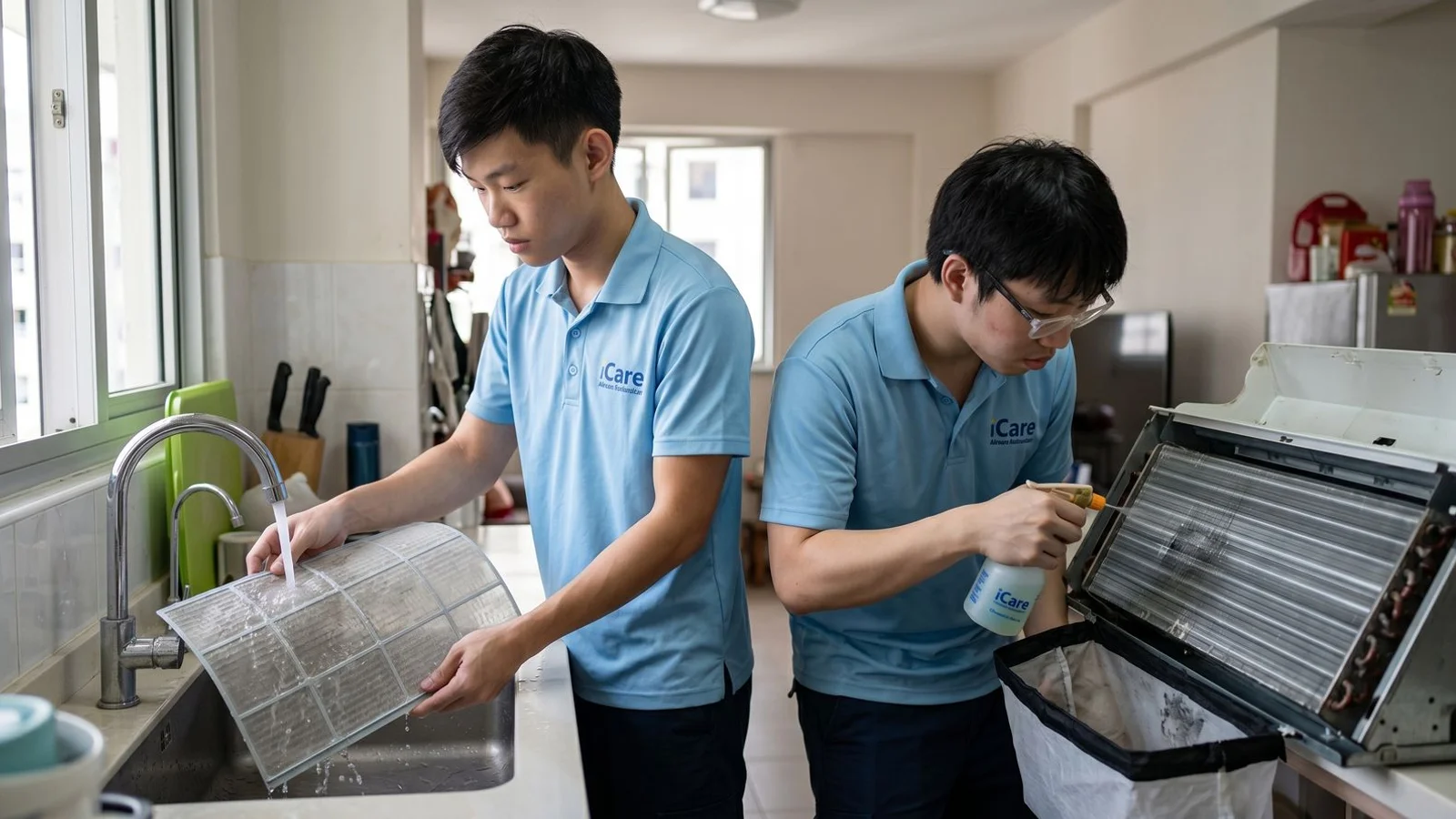
You probably know the feeling of watching that monthly SP Group bill creep up while your living room stays stubbornly warm.
This issue drives Singapore homeowners to ask about the real difference between an aircon chemical wash vs servicing every single week. Our team has seen how a simple misunderstanding here separates a cheap maintenance bill from a massive repair shock since James Tan and Sandra Lim founded iCare Aircon in 2016.
Cost-conscious buyers often try to avoid an unnecessary upgrade by randomly guessing which service they need.
We know that guessing usually leads to overspending. This guide is part of our Aircon Chemical Wash coverage at iCare.
Let’s look at the actual data, explain exactly what each service covers, and show you the exact framework used to diagnose your unit.
Scope Comparison: Aircon Chemical Wash vs Servicing
General servicing covers basic maintenance like washing filters and checking gas, while a chemical wash uses alkaline-based solutions to dissolve stubborn biofilm deep inside the unit. The choice between general vs chemical aircon depends entirely on how deeply the dirt has embedded into your evaporator coils.
We use standard water pressure for general cleaning, but a chemical wash requires dismantling the unit to soak the drainage tray and blower wheel.
| Service Feature | General Servicing | Chemical Wash |
|---|---|---|
| Cleaning Agent | Plain water and mild soap | Alkaline-based chemical solutions |
| Unit Dismantling | Cover and filters only | Full removal of tray and blower |
| Primary Target | Surface dust and minor dirt | Hardened biofilm and deep mould |
This targeted soaking removes the thick jelly-like slime that plain water cannot wash away.
Our technicians regularly see cases where microscopic dust slips past the filter and bakes onto the metal fins. Standard wiping will not clear this hardened layer.
We apply specific chemical agents to safely strip away the buildup without damaging the delicate copper piping. Visualising the difference helps make the right choice.
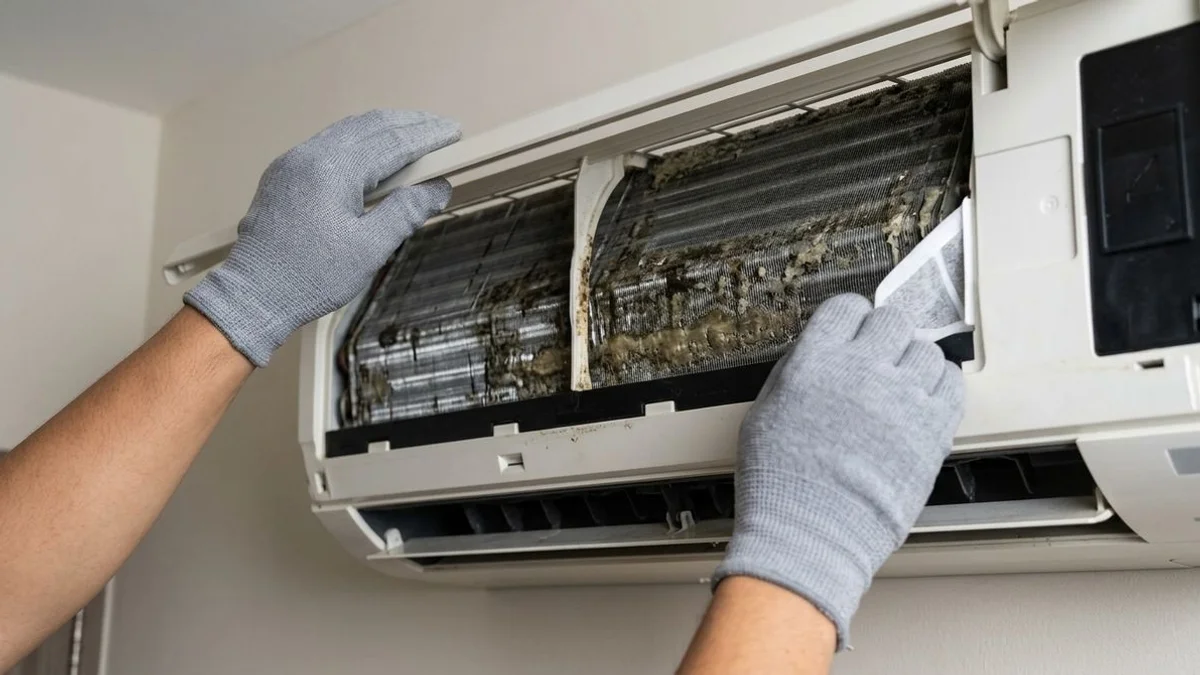
What general servicing leaves untouched
A standard service leaves deep-seated mould, hardened dust on the fan blower, and bacterial slime in the drainage tray completely untouched. This untouched buildup restricts airflow and forces your compressor to work much harder than designed.
We often find that units running on high fan speeds with dirty blowers consume significantly more electricity. The Q2 2026 SP Group electricity tariff sits at 29.72 cents per kilowatt-hour. Our calculations show a struggling compressor running eight hours a night will easily add a noticeable spike to your monthly bill just to overcome that restricted airflow.
Ignoring this hidden mould often leads to a sudden, damaging water leak. We train the team to specifically look for three major issues that a basic wipe-down will miss. These specific problems thrive in Singapore’s 80% average humidity.
- Evaporator Coil Back-Plates: Dust bypassing the filter settles here and solidifies.
- Drainage Pan Biofilm: Bacteria and moisture combine into a thick jelly that blocks the drain pipe.
- Motor Housing Mould: Spores grow in the dark, damp space around the blower wheel.
Aircon Chemical Wash vs Servicing: When is each enough?
General aircon servicing is perfectly fine for routine maintenance every three months if your unit still cools the room quickly and quietly. You need a chemical wash when the air conditioning is dripping water, blowing warm air, or emitting a sour, musty smell.
We recommend setting a strict quarterly schedule for basic maintenance to handle normal dust accumulation. A deep chemical clean becomes necessary about once every 12 to 18 months, or whenever your unit struggles to drop the room temperature.
- Water Leaks: A clear sign the internal drain pan is choked with bio-slime.
- Warm Air: Embedded dirt is blocking the evaporator coil from absorbing heat.
- Foul Odours: Bacterial growth inside the fan blower requires chemical removal.
Our experience shows that delaying a chemical treatment when you smell mould guarantees the bacteria will spread to your walls and curtains. This exact scenario drives recurring service work across Singapore homes.
We evaluate the airflow strength by placing a hand near the vent to check for blockages. Weak airflow despite a high fan setting is a clear sign the internal fins are blocked.
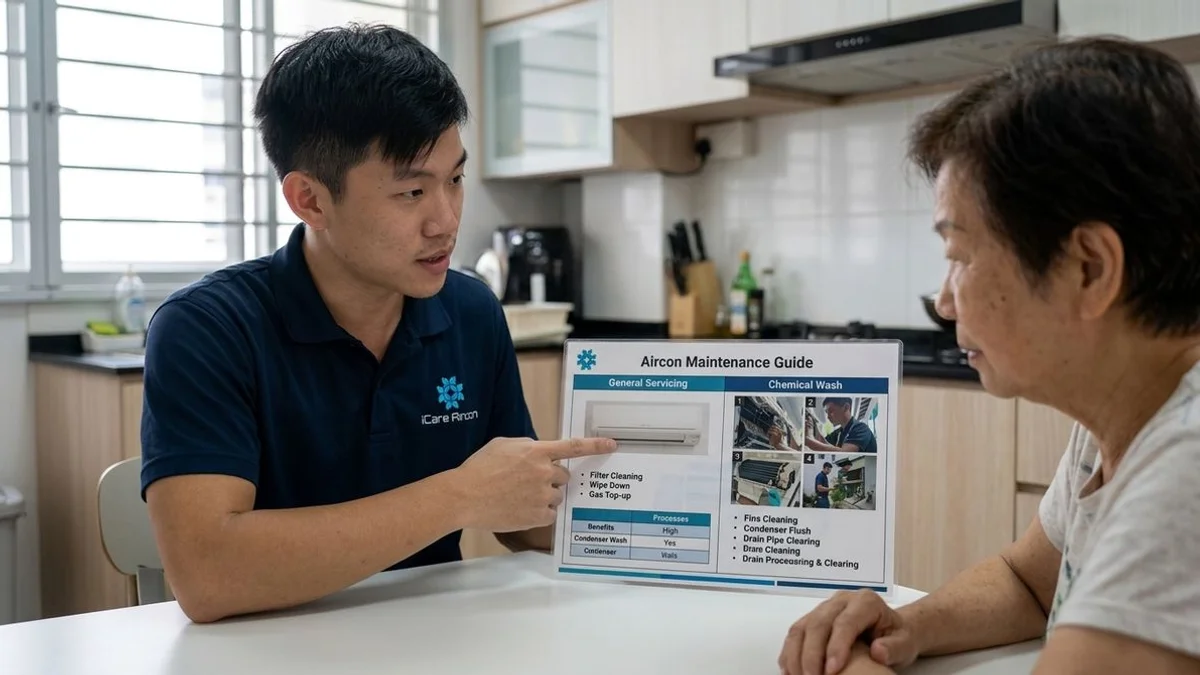
For a related deep-dive, see our guide on What to Expect During an Aircon Chemical Wash Visit.
Technician decision framework iCare uses on diagnosis
The diagnosis framework relies on measuring the temperature drop, checking gas pressure, and physically inspecting the coil condition. Guessing what your unit needs is simply not an option.
We start by measuring the Delta T, which is the temperature difference between the air entering and leaving your unit. An optimal Delta T in Singapore should read between 10 degrees and 12 degrees Celsius.
”A low Delta T reading combined with normal gas pressure is the most reliable indicator that your unit requires a full chemical wash to restore efficiency.”
Our next step involves hooking up a manifold gauge to check the refrigerant gas pressure. A reading below the standard 120 PSI for R410a gas suggests a leak, meaning no amount of cleaning will fix the warm air.
We use these hard numbers to recommend exactly what will solve the problem efficiently. This structured approach prevents recurring service calls and keeps your system reliable.
Cost framing
Paying for regular maintenance is drastically cheaper than recovering from a total system failure. A standard service costs a fraction of the price of replacing major components damaged by neglect.
We frequently see customers delay a minor chemical wash, only to suffer a burnt-out compressor three months later. Replacing an aircon compressor in Singapore currently costs between $600 and $1,200 depending on the specific brand.
| Action Taken | Estimated Cost Impact | Long-Term Result |
|---|---|---|
| General Servicing | $30 to $40 per unit | Prevents light dust buildup |
| Chemical Wash | $80 to $150 per unit | Restores full cooling efficiency |
| Compressor Replacement | $600 to $1,200 | Avoidable with proper maintenance |
Our primary goal is to help you save money by clearing the airflow restrictions before they cause the motor to overheat. This preventative framing is what scopes every visit for Singapore homes.
How iCare Decides On-Site
The technicians decide the right service tier on-site by showing you the exact condition of your internal parts before starting any work. The specific findings are explained clearly to ensure you understand the recommendation.
We inspect coils, drainage, airflow, and gas pressure first. A quick servicing handles the issue if the coils just have a light dusting.
- Visual Inspection: Checking for visible mould on the blower wheel.
- Airflow Test: Feeling for uneven air distribution across the vent.
- Drainage Check: Looking for water pooling in the internal pan.
- Pressure Reading: Verifying refrigerant levels match factory specifications.
We explain the exact reason and provide a quote in writing if a chemical wash, overhaul, or repair is genuinely needed. Pushing the most expensive option is never part of the process. Our transparent approach ensures you only pay for what your system actually requires to run efficiently.
Ready to Book?
Booking a transparent, no-pressure aircon assessment takes just two minutes. You can secure a fixed quote immediately by contacting the local team.
We are ready to restore your cooling efficiency today. If you’re ready, the fastest path is a fixed quote: call +65 3138 2108, message us on WhatsApp, or use the booking form on our contact page.
For more detail on the service itself, see our Aircon Chemical Wash guide, which finally resolves the aircon chemical wash vs servicing debate for your home.
Frequently Asked
Will general servicing fix a musty smell? +
Sometimes — but persistent smells almost always need a wash.
Can I skip the chemical wash if I service quarterly? +
Often yes for low-use rooms; high-use living areas still benefit annually.
How does iCare decide which to recommend? +
We inspect coils, drainage, and airflow before quoting — wash is recommended only when needed.
Ready to Book Aircon Chemical Wash?
Same-day or next-day across Singapore. Fixed quote in writing. 90-day workmanship warranty.
Related Guides
What to Expect During an Aircon Chemical Wash Visit
From cover protection to final cooling test — the exact step-by-step of an iCare chemical wash, typi...
Aircon Chemical Wash vs Chemical Overhaul: Which Do You Need?
Side-by-side: scope, time, price band, and unit-condition triggers for chemical wash ($80-150) vs fu...
How Often Should You Do an Aircon Chemical Wash?
Most Singapore homes need a chemical wash every 12-18 months. See the factors that shorten the inter...
Is an Aircon Chemical Wash Safe for Your Unit and Family?
Yes — when done by trained technicians using NEA-permitted agents. Here's what's used, ventilation t...