
Aircon Repair vs Replacement: When to Make the Call
The 50% rule, age threshold, repeat-fault indicator, energy bill comparison — how to decide between repairing and replacing your Singapore aircon.
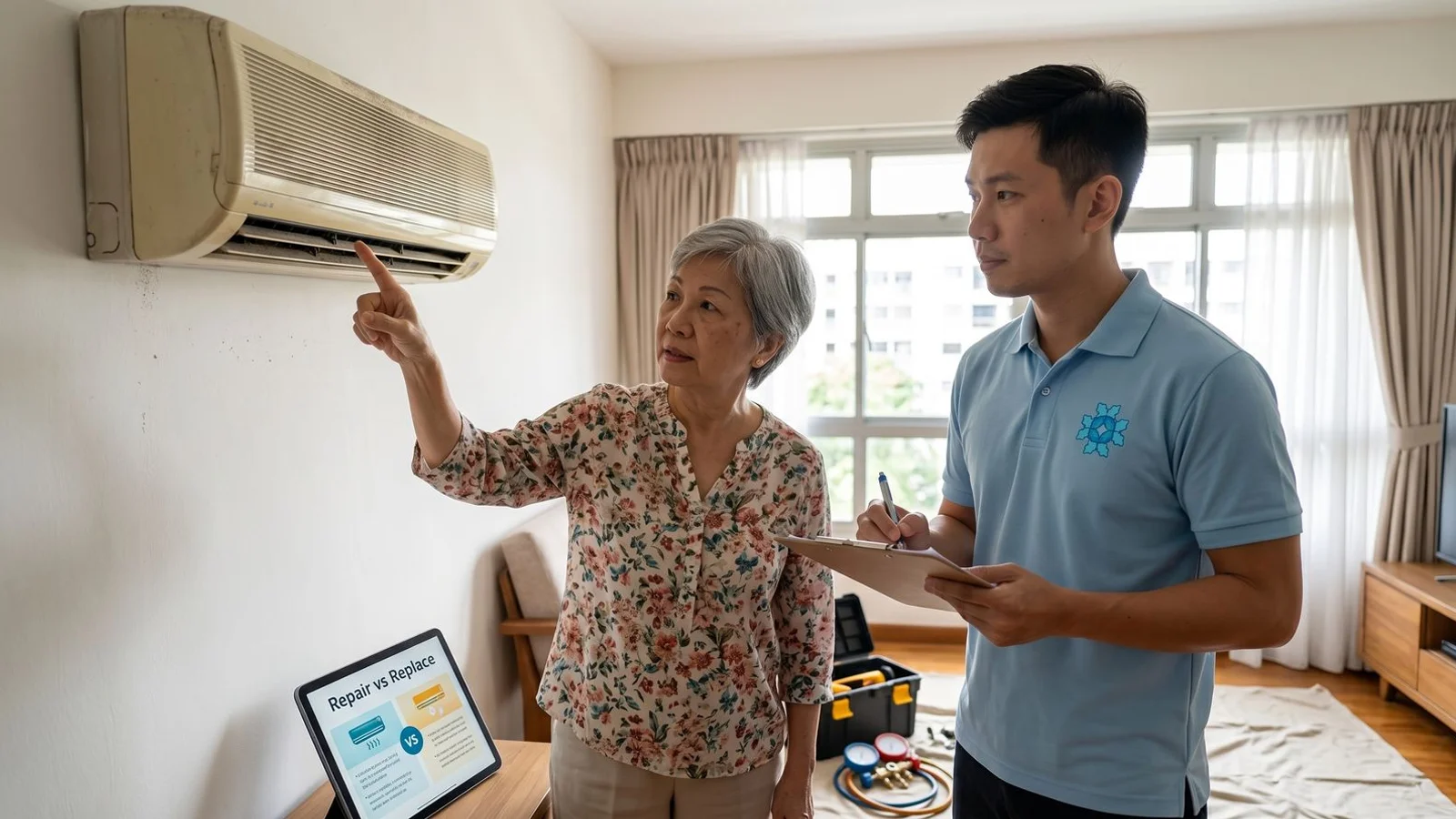
From what our team sees daily across local estates, the debate over aircon repair vs replacement is usually driven by rising power costs rather than total part failure. Constant patching stops making sense once system efficiency drops.
James Tan and Sandra Lim established iCare Aircon in 2016 to provide high-standard air conditioning solutions to owners facing this exact problem. We know that getting this decision right keeps your space comfortable and your SP Group bills manageable. This guide functions as a core piece of the Aircon Repair coverage here at iCare.
The following sections will break down the exact financial thresholds and age limits you need to check before paying for another service call.
The 50% rule for aircon repair vs replacement (if repair > 50% of replacement, replace)
We always start the aircon repair vs replacement conversation by looking at the repair quote. The industry standard dictates that a unit should be swapped out if the quoted fix costs more than half the price of a brand new system.
A replacement compressor in Singapore currently runs anywhere from $300 to over $800 depending on the model. Our technicians use these figures to show why sinking $800 into a dying machine makes poor financial sense.
Repeated gas top-ups at $80 to $150 a visit will quickly eat into any savings you hoped to keep. You should always compare the total repair estimate directly against the retail price of a modern unit.

Age threshold (10+ years for Singapore humidity)
Our service logs show that residential cooling units in local HDB flats generally last between seven to fifteen years. Singapore experiences intense year-round heat and high humidity levels. This climate forces systems to run for extended hours daily, which puts immense continuous stress on the compressor and evaporator coils.
We classify any unit over a decade old as high-risk for major component failure. Parts like the printed circuit board often degrade faster in tropical weather. Finding replacement components for obsolete models from ten years ago is both difficult and expensive.
Our recommendation is to retire an old aircon if it requires frequent maintenance past its tenth year. Upgrading to a new model restores reliable cooling power to your home. Modern systems are built with better anti-corrosion materials suited for tropical environments.
Repeat-fault indicator
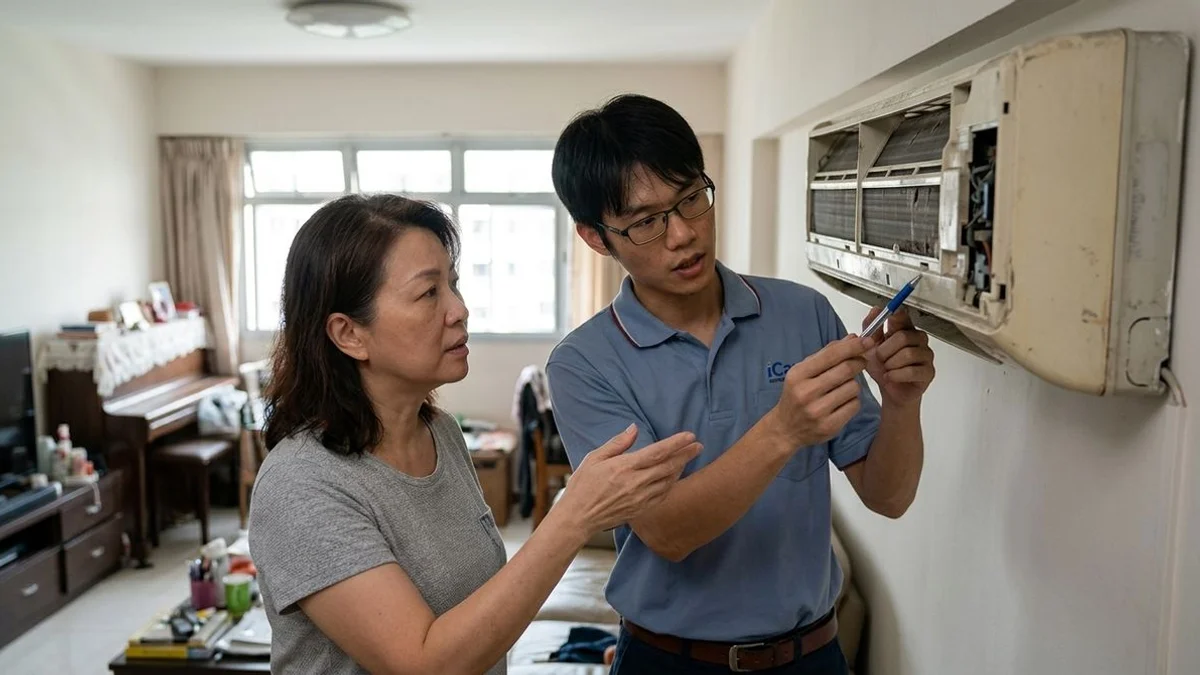
We look closely at service frequency to determine if an old aircon is worth fixing. A system that breaks down repeatedly within a single year is a clear sign of cascading hardware failures. You should watch out for a few specific recurring issues that signal the end of a unit’s lifespan:
- Persistent water leaks: This often indicates severely compromised drainage pipes or heavily degraded coils.
- Frequent gas top-ups: Refrigerant should never deplete naturally, so needing gas means there is an active leak.
- Strange noises: Grinding or rattling sounds point to failing fan motors or loose internal components.
We often encounter cases where a simple gas top-up only masks a much larger refrigerant leak hidden deep inside the piping. Paying for a $120 chemical wash every few months just to keep a struggling system alive is a losing battle. Those constant minor service fees could easily fund a completely fresh, reliable setup.
For a related deep-dive, see our guide on Aircon Blinking Light: Singapore Troubleshooting Guide.
Energy bill comparison and NEA tick-rating savings
We tell customers that the fastest way to justify a replacement is to look at their monthly SP Group statement. Older models consume significantly more power to produce the same amount of cooling as modern units.
As of the second quarter of 2026, the local electricity tariff sits at 27.27 cents per kilowatt-hour before taxes.
Our calculations show that running an outdated, inefficient system at these rates will cost you heavily over time. Data from the National Environment Agency indicates that switching from a 2-tick to a 5-tick multi-split system saves roughly $300 annually. Heavy users who run their systems for eight hours a day can see savings closer to $470 every year.
| NEA Tick Rating | Compressor Technology | Projected Annual Savings (vs 2-Tick) |
|---|---|---|
| 2-Tick Rating | Fixed-speed compressor | Baseline Cost |
| 5-Tick Rating | Advanced inverter technology | $300 to $470 per year |
We use a straightforward table to illustrate how these energy savings offset the initial purchase price. A high-efficiency unit practically pays for itself within the first few years of operation. Upgrading is the most logical step to combat rising energy costs.
ICare’s diagnostic-first approach
Our diagnostic-first approach ensures you never pay for unnecessary parts or premature replacements. The typical service visit begins with a thorough inspection of the coils, gas pressure, and drainage systems. This objective assessment reveals the true health of the cooling unit.
We measure the exact refrigerant levels to rule out hidden leaks before recommending any major work. Testing electrical continuity on the printed circuit board helps isolate the exact point of failure. Identifying these specific faults prevents a minor sensor issue from being misdiagnosed as a dead compressor.
Our technicians will then present you with a clear, itemised report of the findings. You retain full control over the final decision without any aggressive upselling tactics. Transparency builds the foundation of a reliable service experience.
How iCare Decides On-Site
We always prioritise the most practical and cost-effective tier of service when you need to decide whether to repair or replace aircon units. A simple general servicing at $30 to $60 per unit is often enough to resolve minor airflow blockages.
Deeper cleaning methods become necessary only when heavy dust and mould severely restrict the condenser coils.
Our technicians will clearly explain why a chemical overhaul is required before drafting any quotes. Every proposed fix is detailed in writing so that you understand exactly what the process entails.
Sourcing quality original equipment manufacturer parts ensures that any repaired component lasts longer.
We refuse to push a full replacement unless the current machine poses a safety risk or a severe financial drain. The final choice rests entirely in your hands. Having the right facts makes that choice incredibly simple.
Ready to Book?
Our scheduling team is ready to secure a fixed quote for your next service visit. The fastest path to a cool room is to call +65 3138 2108 directly, message the support desk on WhatsApp, or use the booking form on the contact page.
Professional help today will stop those minor issues from turning into expensive disasters. We suggest reading through the main Aircon Repair resource for more details on the process itself.
A well-maintained cooling system guarantees a comfortable environment all year round, which effectively settles the aircon repair vs replacement debate for good.
Frequently Asked
How long does a Singapore aircon typically last? +
10-15 years with regular servicing; coastal-facing units lean shorter.
Will replacement actually lower my SP Group bill? +
Often yes — moving from a 1-2 tick old unit to a 4-5 tick inverter saves 30-50%.
Should I replace one unit at a time? +
Usually yes — staggered replacement spreads the cost and matches lifespan.
Ready to Book Aircon Repair?
Same-day or next-day across Singapore. Fixed quote in writing. 90-day workmanship warranty.
Related Guides
Aircon Blinking Light: Singapore Troubleshooting Guide
What blinking lights mean, how to read the pattern, safe reset steps, and when to bring in a technic...
Aircon Error Codes Guide: Daikin, Mitsubishi, Panasonic
Plain-English error code reference for the major Singapore aircon brands — what each common code mea...
Aircon Leaking Water in Singapore: Causes and Fixes
Water dripping from your indoor aircon? Causes (clogged drain, slanted unit, frozen coil) and how to...
Bad Smells from Your Aircon — What They Mean
Musty, burning, chemical, dirty-sock — each aircon smell type means something different. See what's ...